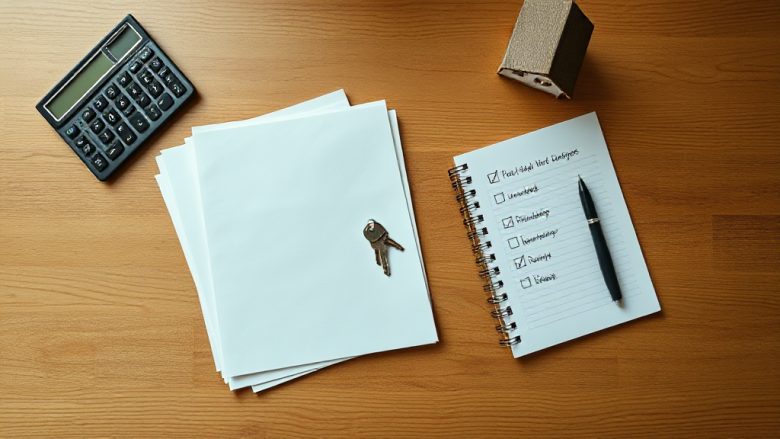
Buying your first home is supposed to feel exciting, and it does — for about five minutes. Then the paperwork starts, and suddenly you’re drowning in acronyms like LTV, APR, and ERC, wondering why nobody taught you this in school. The mortgage process isn’t actually complicated once you break it into pieces. It just feels that way when you’re staring at the whole thing at once. That’s why a mortgages checklist for first timers works so well: it turns a maze into a sequence. You do step one, then step two, and somewhere along the way you stop panicking and start packing boxes. Below is the exact order I’d follow if I were starting over, from the first bank statement you dig up to the day you get the keys.
Phase 1: Prepare Before You Even Look at Houses
Most first-timers do this backwards. They fall in love with a listing, then scramble to figure out if they can afford it. Flip that. Your preparation phase is boring, but it’s the part that decides everything else.
Start with your credit report. Pull it, read it, and check for errors — a wrong address or a settled debt still showing as active can knock points off your score for no reason. Disputes take weeks to resolve, so do this early, not the week you apply. While you’re at it, stop opening new credit cards or financing a car. Lenders look at recent activity, and a fresh loan right before a mortgage application makes you look riskier than you are.
Next, get honest about your deposit. You’ll typically need at least 5% of the purchase price, though 10% or more opens up better rates. Don’t forget the costs that sit outside the deposit: valuation fees, legal fees, surveys, and moving costs. A rough rule is to budget an extra 2–4% of the property price for these. If your deposit leaves you with nothing in savings afterward, you’re not ready yet — you’re one boiler breakdown away from trouble.
Finally, gather your documents before anyone asks for them. You’ll almost certainly need:
- Photo ID and proof of address from the last three months
- Three to six months of bank statements, all accounts
- Payslips from the last three months, or two years of accounts if self-employed
- Proof of your deposit source — savings, gift letter, sale of an asset
- Recent utility bills or council tax statements
Having these in one folder saves you a week of email ping-pong later.
Phase 2: Work Out What You Can Actually Afford
There’s a difference between what a lender will offer you and what you can comfortably repay. Lenders tend to multiply your income by around 4 to 4.5 times, sometimes more. That number can be flattering. It can also be a trap.
Run your own budget first. Add up your current monthly outgoings — rent, bills, food, transport, subscriptions, everything — then add the new costs a home brings: buildings insurance, life cover if you take it, maintenance, and higher utility bills. Compare that total to the mortgage payment you’re considering. If the gap is thin, borrow less. A mortgage is a 25- or 30-year commitment, and rates move. Stress-test yourself: could you still pay if the rate rose by two percentage points? If the answer is no, reduce your budget now rather than later.
This is also the moment to decide on the type of deal. Fixed rates give you certainty for a set period, usually two to five years. Tracker or variable rates move with the market and can be cheaper, but they carry risk. For a first home, most people sleep better with a fixed rate, at least for the first term. There’s no universally right answer — only the one that matches your tolerance for uncertainty.
Phase 3: Compare Deals Without Getting Lost
Once you know your budget, you can start shopping. A mortgage broker can save you real time here, especially if your situation is slightly unusual — self-employed, a recent mover, or buying with a friend. Brokers access deals you might not find on your own, and they handle the paperwork. Some charge a fee; some are paid by the lender. Ask upfront which applies.
If you go it alone, compare on more than the headline rate. Look at the arrangement fee, the valuation fee, early repayment charges, and whether the deal includes free legal work. A rate that’s 0.1% lower but comes with a £1,500 fee might cost you more over the fix period. Add up the total cost over the deal term, not just the monthly payment.
Get a Decision in Principle before you view anything seriously. It’s a soft check that tells sellers you’re a credible buyer, and it usually lasts 60 to 90 days. It isn’t a guarantee, but it stops you wasting weekends on homes that were never going to work.
Phase 4: Apply, Then Survive the Waiting
When your offer is accepted, the clock starts. Submit your full application promptly — delays here can cost you the property if the seller gets twitchy. Your lender will arrange a valuation, which is for their benefit, not yours. It confirms the property is worth what they’re lending against. It’s not a survey. Pay for your own survey separately; it’s the only thing that tells you whether the roof is about to fail.
Then comes the quiet stretch. Underwriting can take two to six weeks, longer if your case is complex. Answer any queries the same day if you can. Don’t change jobs, take out new credit, or move large sums between accounts without telling your lender — all three can trigger awkward questions right when you least want them.
Meanwhile, your solicitor handles searches, contracts, and the transfer of funds. Keep in touch with them and with your estate agent so nobody is waiting on somebody else. Most delays in a first purchase come from silence, not from genuine problems.
Phase 5: Close, Complete, and Avoid the Classic Mistakes
Completion day is the finish line. Your solicitor draws down the mortgage funds, the balance is paid to the seller, and the keys are released. Before that happens, make sure buildings insurance is in place from the day you exchange contracts — not the day you move in. Between exchange and completion, you’re legally committed, and if something happens to the property, you want cover.
The mistakes first-timers make are remarkably consistent. They borrow the maximum and leave no cushion. They skip the survey to save a few hundred pounds and inherit a five-figure problem. They forget that stamp duty, legal fees, and removals come out of the same pot as the deposit. They let their credit file go stale or messy mid-application. And they treat the mortgage as the end of the process, when really it’s the start of a long relationship you’ll need to revisit when your fixed term ends.
Work through these five phases in order, and the whole thing shrinks from terrifying to tedious. Tedious is fine. Tedious gets you a home.
Frequently Asked Questions
How much deposit do I really need as a first-time buyer?
Five percent is the common minimum, but ten percent or more usually gets you a better interest rate. The deposit isn’t the only cost, though — budget an extra two to four percent of the purchase price for fees, surveys, and moving.
Should I use a mortgage broker or apply directly?
If your finances are straightforward, comparing deals yourself is perfectly doable. If you’re self-employed, have irregular income, or are buying with someone else, a broker often earns their fee by finding deals and chasing paperwork you’d otherwise have to manage alone.
Can I apply for a mortgage before I’ve found a property?
Yes, and you should. A Decision in Principle gives you a realistic budget and shows sellers you’re serious. It usually lasts 60 to 90 days, so time your search accordingly.
What happens if my fixed rate ends and I do nothing?
You roll onto the lender’s standard variable rate, which is almost always more expensive. Diarise your deal’s end date and start comparing new deals about three to six months before it expires.